

GMP Cleanroom Construction Services: Professional Design and Build for Sterile Environments
2026-08-07
In industries where sterility is paramount, the foundation of product safety and regulatory compliance lies in the design and construction of cleanrooms. At GENO Pharmatech, we recognize that every square foot of a controlled environment must be meticulously planned—from airflow dynamics to material selection—to eliminate contamination risks. Our turnkey approach to GMP cleanroom construction transforms complex specifications into operational realities, ensuring your facility not only meets but exceeds global standards. Discover how our integrated design-build process delivers sterile spaces that safeguard your processes and elevate your production capabilities.
Tailored Cleanroom Design Aligned with Your Exact Process Needs
Every manufacturing or research process carries its own set of environmental demands, and a one-size-fits-all cleanroom simply cannot deliver the precision required. We begin by analyzing your specific workflow, from particle sensitivity and temperature gradients to humidity tolerances and electrostatic discharge risks. This deep dive allows us to map out a controlled environment that integrates seamlessly with your operations, rather than forcing you to adapt around generic specifications.
Our design philosophy moves beyond standard classifications. Whether you need modular walls that can be reconfigured as your process evolves, or specialized filtration cascades to handle airborne molecular contamination, the layout and materials are selected solely to protect your product. We account for equipment heat loads, operator movement patterns, and future scalability from the very first sketch, ensuring that the facility remains efficient and compliant without unnecessary complexity.
The result is a space where every surface, airflow path, and monitoring point serves a clear purpose tied directly to your production goals. By eliminating assumptions and building around actual data from your process, we create cleanrooms that reduce contamination risks while maintaining practical usability. It’s a tailored fit—no more, no less than what you truly need.
Navigating Regulatory Compliance Without the Headaches
Compliance can feel like wading through an endless swamp of rules, but it doesn’t have to be a nightmare. By breaking down requirements into manageable chunks and focusing on what truly applies to your operations, you can build a system that works in the background. The key is to stop treating compliance as a one-time fire drill and instead weave it into your daily processes—automation and clear documentation do the heavy lifting, so you’re not scrambling when audits come around.
Too many companies get stuck in a reactive cycle, hunting down spreadsheets and chasing signatures at the last minute. Instead, map out your obligations early, assign ownership, and set up regular check-ins. Simple tools like shared calendars and automated reminders can transform chaos into routine. When everyone knows their piece of the puzzle, the whole picture stays intact without the stress.
The real magic happens when you shift your mindset from mere avoidance of fines to building trust. Clear, consistent compliance practices not only keep regulators at bay but also show partners and customers that you’re serious about doing things right. It’s not about perfection—it’s about demonstrating genuine effort and having a trail that backs it up.
Precision Construction That Respects the Science Behind Sterility
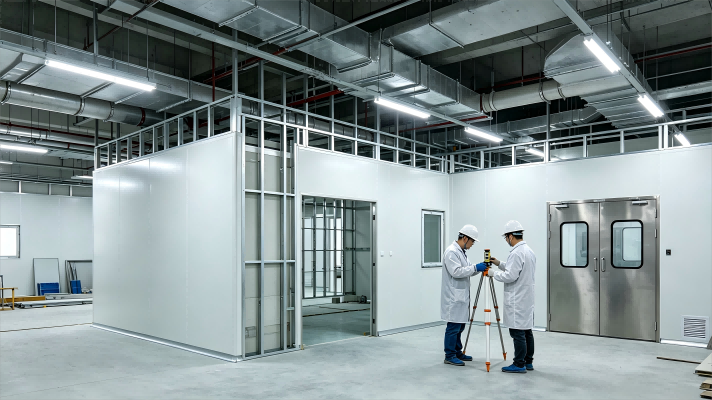
Every seam, joint, and surface in a sterile environment is a potential breach point. We approach construction not as a series of generic build steps, but as a controlled experiment. Materials are selected for their inertness and thermal stability, not just their durability. Stainless steel grades are matched to exacting cleanroom classifications—type 316L for aggressive chemical exposure, electro-polished to Ra ≤0.5µm where particle adhesion must be negligible. Even the welding gas backing mixtures are specified to prevent sugaring that would trap bioburden.
The sequence of assembly is driven by contamination risk modeling. Drywall and painting happen before ductwork is hung, not after. Every penetration is sealed in a staged sequence, with post-seal integrity testing that goes beyond smoke pencil checks—we use tracer gas decays and particle condensation nuclei counters to validate isolation boundaries. These data points feed into a dynamic risk register that adjusts the construction schedule in real time, ensuring that no activity outruns the ability to maintain a validated state.
Our commissioning phase treats the facility as a scientific instrument. Temperature mapping verifies cold chain boundaries and differential pressure cascade stability under worst-case open-door scenarios. We validate cleanroom recovery rates to ISO 14644-2 with discrete particle counters, not just settle plates. Then we integrate this data with your quality systems, creating a live digital twin that correlates construction details with operational performance, so you’re not just handed keys—you inherit a scientifically defensible baseline.
Integrating Advanced Technologies Without Overcomplication
Striking the right balance when weaving new tools into existing workflows starts with a clear-eyed assessment of actual needs, not just excitement over features. It’s tempting to layer on every innovation that promises efficiency, but the real art lies in choosing only what genuinely removes friction for the people using the system daily. By anchoring decisions to concrete user pain points rather than abstract potential, teams sidestep the clutter that turns promising upgrades into productivity drains.
A practical approach involves building around a core, minimal stack that everyone understands, then extending it cautiously and only when the value is undeniable. This means resisting the urge to adopt something simply because competitors are—or because it sounds impressive in meetings. Instead, prioritize seamless connections between the tools already in place, and introduce new layers only after running small, quick tests that reveal whether the added complexity is worth the lift.
Communication plays an outsized role here. When technical teams articulate the “why” behind each integration in plain, relatable terms, it demystifies the process and earns trust. Pair that with a habit of regularly pruning redundant or underused plugins, and you create an environment where advanced technology feels like a natural extension of daily work, not a constant source of background noise. The goal isn’t to have the most components, but to have the right ones working together so quietly that they almost disappear.
Validation and Testing Protocols That Leave Nothing to Chance
When precision matters, our validation and testing protocols go beyond routine checklists. We start by mapping out every possible failure point—whether it’s a subtle data inconsistency or a hardware interface glitch—and design targeted stress tests that push systems to their limits. Nothing is assumed to work as expected until it’s proven under real-world conditions, often with deliberately erratic inputs to see where the cracks might form.
The process is iterative and almost obsessive in its detail. Test engineers simulate edge cases that most teams overlook: fluctuating power supplies, corrupted firmware updates, or cascading dependency failures. Each round of testing is followed by root-cause analysis that doesn’t just fix the symptom but re-engineers the underlying architecture to prevent recurrence. This isn’t about passing a test suite; it’s about building a system that holds up when the unexpected happens.
Before any release, we run blind validation exercises where fresh teams—unfamiliar with the initial design—try to break the system without prior guidance. Their fresh eyes catch assumptions buried in the original specifications. Combined with automated regression pipelines that evolve with every bug found, our protocols create a safety net so thorough that surprises in production become vanishingly rare. When we say we’ve validated something, it means we’ve tried everything to disprove its reliability and failed.
Ongoing Support That Keeps Your Controlled Environment in Peak Condition
Our commitment doesn’t end at installation. We provide proactive, tailored maintenance schedules that adapt to your facility’s unique demands, ensuring every component of your controlled environment operates at its best. From fine-tuning temperature and humidity controls to inspecting filtration systems, our technicians work meticulously to prevent issues before they arise. This hands-on approach minimizes unexpected downtime and keeps your operations running smoothly, day in and day out.
When challenges do surface, our response is swift and precise. We combine deep technical expertise with real-time diagnostics, often resolving concerns remotely or dispatching specialists who arrive equipped with the exact parts needed. You’re never left waiting on generic solutions—every action is purpose-driven to restore optimal conditions quickly, protecting your sensitive processes and equipment from costly disruptions.
Beyond immediate fixes, we help you optimize for the long haul. Our team regularly reviews system performance data, suggesting refinements that enhance efficiency and extend equipment lifespan. It’s a collaborative effort: we listen to your observations, adapt our strategies, and share insights that empower your staff. The result is a controlled environment that doesn’t just maintain standards but continuously improves, giving you confidence in every outcome from research to production.
FAQ
A GMP cleanroom is a controlled environment where airborne particles, temperature, humidity, and pressure are tightly regulated to meet Good Manufacturing Practice standards. It’s essential because even microscopic contamination can compromise drug safety or device efficacy. Without one, you simply can’t guarantee product sterility or pass regulatory scrutiny.
Ideally, from the concept stage. Bringing us in before architectural drawings are finalized lets us integrate cleanroom requirements seamlessly, avoiding costly redesigns later. We’ll help you define the ISO class, layout, material flows, and utility needs right when it matters most.
We typically use smooth, non-shedding, chemical-resistant surfaces like high-pressure laminate panels or epoxy-coated walls paired with monolithic vinyl or resin flooring. The key is avoiding crevices where microbes hide and ensuring the finishes withstand repeated harsh cleaning without degrading.
It comes down to precise pressure cascades, HEPA filtration placement, and careful mapping of supply and return air paths. We use computational fluid dynamics during design to visualize flow patterns, then validate with on-site testing to confirm no dead zones or turbulence that could spread contamination.
Qualification is a multi-step process—starting with installation checks, then operational testing of HVAC and interlocks, and finally performance qualification under simulated production. We handle IQ, OQ, and PQ protocols, and we stick around until everything meets the acceptance criteria you need for your audit.
We don’t do cookie-cutter layouts. For aseptic filling, we might add restricted access barriers and focus on first-pass air. For solid dose, it’s more about containment and dust control. The design pivots on your particle risk assessment—we map your process first, then build the environment around it.
We provide post-construction audits and can redesign HVAC or modify finishes if standards shift. Many clients keep us on a retainer for periodic reviews, so when Annex 1 updates or FDA guidance evolves, we can implement tweaks before it becomes a compliance headache.
By value-engineering early on—selecting the right ISO classification zones, optimizing layout to reduce square footage, and using prefabricated panels where it makes sense. Sterility isn’t compromised because we focus your budget on critical areas like air handling and finishes while trimming non-essential frills.
Conclusion
GMP cleanroom construction demands far more than just assembling walls and filters—it requires a seamless fusion of process understanding, regulatory acumen, and construction precision. Every design choice begins with a deep dive into your specific workflow, ensuring the layout, materials, and airflow patterns are tailored exactly to your operational needs. This eliminates unnecessary complexity while building in the flexibility for future adaptations. Simultaneously, navigating the maze of GMP guidelines, ISO classifications, and regional regulations is handled proactively, so compliance becomes an integral part of the design rather than an afterthought. The result is a sterile environment that not only meets but anticipates the rigorous demands of pharmaceutical, biotech, and medical device manufacturing.
Construction itself is executed with a scientific mindset, where every joint, surface, and utility penetration is treated as a potential contamination vector. Advanced technologies—such as real-time monitoring, intelligent HVAC controls, and pass-through chambers—are integrated in a way that enhances operational efficiency without overwhelming your team. The process culminates in exhaustive validation and testing protocols, from HEPA filter integrity checks to airflow visualization and particle counts, leaving no room for uncertainty. Even after handover, ongoing support ensures your cleanroom maintains peak performance through planned maintenance, recalibration, and staff training, effectively safeguarding your investment and product integrity for the long term.
Contact Us
Contact Person: Amy Yang
Email: [email protected]
Tel/WhatsApp: 008619330882686
Website: https://www.genopharmatech.com/