

OEM Stainless Steel D Shackle Buying Guide for Marine and Industrial Use
2026-10-20
Picking the right stainless steel D shackle for marine or industrial work isn't just about grabbing the first shiny option—load limits, corrosion resistance, and OEM customization all come into play. This buying guide breaks down what actually matters, from material grades to dimensional tolerances, so you can avoid costly failures down the line. And if you need hardware that survives salt spray, heavy lifts, and everything in between, Wanluo has been forging dependable shackles for demanding jobs. Let's get into the details.
What Actually Matters in a Stainless Steel D Shackle Load Rating
Most buyers glance at a shackle's stamped number and assume that's the whole story, but load rating on a stainless steel D shackle is layered. The working load limit (WLL) is not a breaking point; it's a conservative ceiling derived from the ultimate break strength after dividing by a safety factor—commonly 5:1 or 6:1 depending on the standard. A shackle marked '1T' doesn't snap at one tonne; it's designed to handle repeated lifts at that load without deformation, while its actual failure point might sit five or six times higher.
What separates a trustworthy rating from a vanity stamp is rarely visible at a glance: pin fit, thread engagement, and forging consistency. A loose pin concentrates stress at the ears, quietly lowering the real capacity even if the body is thick. Likewise, cast stainless steel often carries the same WLL as forged on paper, but the grain structure is weaker under shock loads. Check whether the load figure references a recognized standard like EN 13889 or ASME B30.26, and verify that the pin diameter matches the rated capacity—undersized pins are a common shortcut in budget shackles.
Why 316 Stainless Steel Beats 304 in Saltwater
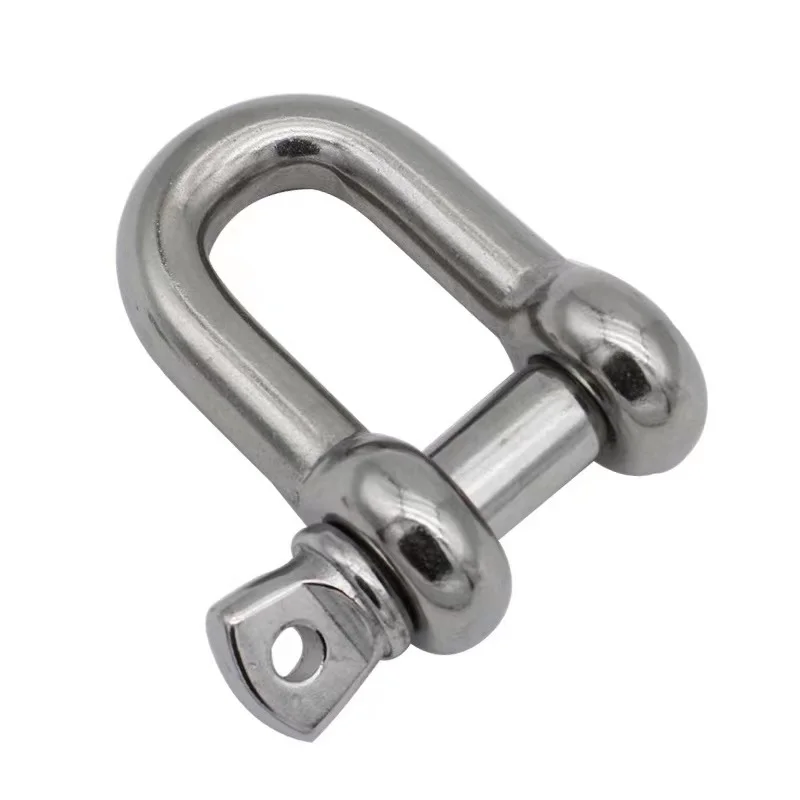
When you're building for marine environments, the real fight is against chloride corrosion. Type 304 stainless has around 18% chromium and 8% nickel, but it lacks the secret weapon that 316 brings to the table: molybdenum. That single addition, typically 2-3%, dramatically shifts how the alloy behaves in salt spray, tidal zones, and even just humid coastal air.
Saltwater doesn't just cause surface rust; it attacks the passive oxide layer that normally protects stainless steel. Chloride ions are small and aggressive—they can break through that film and create pits that tunnel deep into the metal. On 304, those pits spread quickly, leaving behind ugly corrosion and compromised strength. Because 316 contains molybdenum, its passive layer is much more stable in chloride-rich environments, so pitting and crevice corrosion get suppressed before they can gain a foothold.
This isn't just lab talk. Boat railings, dock hardware, and underwater fittings made from 304 often show brown staining and small pits within a few seasons near the ocean. Swap to 316, and the same parts stay clean and structurally sound for a decade or more. For anyone who hates replacing corroded hardware every couple of years, the upgrade pays for itself.
OEM Shackle Customization Without the Guesswork
We’ve rebuilt the OEM shackle process around clarity, not assumptions. Every project starts with a single technical worksheet that captures load ratings, material grades, coating specs, and dimensional tolerances in plain language. No back-and-forth emails trying to decode vague “standard size” requests. You tell us the working load limit, the pin type, the finish, and the batch quantity—and we lock those details into a pre-production sample before a single shackle is forged.
What often gets lost in customization is the difference between “close enough” and “fit for purpose.” Our engineering team reviews every drawing against real-world failure modes: fatigue at the crown, wear in the pin eye, galvanic corrosion between dissimilar metals. If a spec needs adjustment—say, a larger radius to reduce stress concentration—we raise it before tooling begins. That’s the guesswork removal: you’re not just getting a quote, you’re getting a sanity check on your design from people who machine shackles every day.
Once the sample is approved, we issue a locked manufacturing ticket with photos, hardness test results, and dimensional reports tied to your order number. Reorders don’t start from zero—they reference your archived specs, so the next batch matches the last one within thousandths of an inch. You keep your supply chain predictable, and your rigging crew never has to wonder if the new shackles will fit the same lifting slings. That’s customization without the headache.
Spotting Fake Stainless Steel Before You Buy
A quick magnet test can reveal a lot, but it's not foolproof. Authentic stainless steel is often only weakly magnetic or entirely non-magnetic, depending on its alloy. If a seller claims a piece is high-quality 304 or 316 stainless and it clings firmly to a magnet, treat that as a red flag, not a final verdict.
Look closely at the finish and weight. Real stainless has a consistent, slightly cool-to-the-touch surface with a solid heft. Cheap imitations may feel light, show uneven polishing, or display tiny pits, rough edges, or discoloration that hints at a thin plating over a weaker base metal.
Ask for the grade. Reputable vendors can tell you exactly what you're buying—typically 304 for everyday use or 316 for marine and acidic environments. If they dodge the question or only say 'stainless steel,' you might be looking at a low-nickel or coated alloy that will rust once the coating wears through.
Pin Types and When a Screw Pin Makes Sense
In mechanical assemblies, pins rarely get much attention until one backs out or shears off. The family is broader than most people realize: straight dowel pins rely on interference fit and are a pain to remove, taper pins wedge themselves tighter under load but need reaming, and cotter pins are really just bent-wire insurance against a nut loosening. Each has a place, but none of them give you a positive, reusable locking force in the axial direction without some extra part or permanent deformation.
A screw pin changes that equation. Instead of a smooth shank that depends purely on friction or a separate retaining clip, it has threads on one end—either external to accept a nut or internal to take a bolt. The other end can be a hex head, a slotted drive, or even a plain cylindrical body for alignment. That threaded portion lets you draw the pin tight against a surface, so it resists vibration, axial pull-out, and rotation all at once. It behaves less like a passive dowel and more like a small, specialized fastener.
So when does a screw pin actually make sense? Think about joints where you need a pivot or a locating feature but also need to prevent the pin from walking out under cyclic load. Think about assemblies you’ll open and close many times—pulling a press-fit dowel every maintenance cycle chews up the bore, while a screw pin unscrews cleanly. Thin-wall or soft materials also benefit, because you can tap the hole and thread the pin in instead of relying on an interference fit that might crack the parent metal. If the pin has to carry both shear and tension, or if you simply want to remove it without a hammer and a punch, the threaded option earns its keep.
Matching Shackle Size to Real Marine and Industrial Loads
Choosing the right shackle size isn't just about matching a number on a chart—it's about understanding how the load actually behaves in the field. A marine lifting operation in a rolling sea imposes dynamic forces far beyond the static weight, whereas an industrial hoist moving a rigid beam may follow a more predictable path. Forging a shackle that fits means reading the environment first: saltwater corrosion, shock loading from sudden stops, and the angle at which slings pull all shift the effective stress on the pin and bow. Oversizing may seem safe, but it adds unnecessary weight and swing clearance issues, while undersizing risks catastrophic failure. The real skill lies in factoring the working load limit not as an absolute ceiling, but as a baseline adjusted by real-world conditions like side loading, temperature swings, and repeated cycles.
In marine settings, shackles often live in a hostile zone where waves and wind create unpredictable vector forces. A shackle rated for a calm harbor lift can fail prematurely when the same load is hoisted from a supply vessel heaving in a four-meter swell. The type of connection matters too: a screw pin shackle may work fine for a static tie-down, but for a subsea lifting sling that rotates under load, a bolt-type shackle with a secured nut and cotter pin prevents accidental loosening. Industrial loads present their own quirks—overhead cranes in steel mills deal with thermal expansion, while mining hoists face abrasive dust that accelerates wear on the bearing surfaces. Matching the shackle to the load means asking not just “how heavy?” but “how does this load move, twist, and fight back over time?”
A practical approach starts with calculating the resultant force on each shackle, not the total load divided by the number of legs. When a two-leg sling lifts at a 60-degree angle, each leg sees more than half the load—sometimes significantly more. Then layer in the safety factor required by your industry code; offshore lifting standards often demand a 5:1 or 6:1 design factor on top of the working load limit, while a simple warehouse lift may only need 4:1. Don't ignore the throat opening either: a shackle pin needs enough clearance for the sling eye or hook to rotate freely without binding, because friction there can induce bending moments that reduce rated capacity. Finally, consider the pin diameter relative to the hole it passes through—a loose fit accelerates wear and allows the pin to work itself out under vibration. The goal isn't the biggest shackle you can afford, but the smallest one that handles the true, dynamic, worst-case load without compromise.
FAQ
Saltwater demands more than a basic stainless grade. Look for 316 stainless with molybdenum content, which resists pitting far better than 304. Also check that the pin and body are both made from the same alloy, otherwise galvanic corrosion can eat away the weaker part. A smooth electropolished finish helps prevent salt crystals from clinging and triggering crevice corrosion.
The WLL tells you the maximum safe load under normal pulling conditions. Never match it exactly to your expected load—leave a healthy margin for shock loading, side loading, and wear. For marine mooring or industrial rigging, many operators choose a shackle with a WLL at least four to five times the static load, especially when dynamic forces come into play.
Not always. 316 wins in wet, salty environments because of added molybdenum, but it costs more and is slightly softer than 304. If your shackle lives on a trailer or in a dry industrial setting, 304 can be a practical and economical choice. The real weak point is often the pin threading, so inspect that regardless of grade.
Most manufacturers offer OEM services that go beyond a stamped logo. You can request specific batch numbers, load ratings, or your own branding on the body or pin. Some will also produce non-standard dimensions or unique pin lengths if your rigging setup calls for it. Expect longer lead times and minimum order quantities for deep customization.
Look for proof of testing rather than just a CE mark. A reputable shackle will have documentation showing it meets EN 13889 or similar standards, and for offshore use you might see DNV or ABS type approval. The certificate should list the WLL, traceable heat number, and the exact stainless grade, not just 'stainless steel'.
Give it a visual once-over for cracks, bends, or deep scratches, especially around the pin hole and bow. Wiggle the pin to check for thread slop or deformation. If the shackle has been overloaded, don't straighten it and put it back to work—retire it. Saltwater users should rinse with fresh water and check for crevice corrosion near the pin shoulder.
Bolt-type shackles with a nut and cotter pin suit permanent or long-term rigging where the connection should not loosen. Screw pin shackles are quicker to open and close, which is handy when you frequently change rigging. For overhead lifting, many safety codes lean toward bolt-type because the nut cannot unscrew by itself under vibration.
Forged shackles are worked under high pressure, aligning the metal's grain structure and making them tougher under shock loads. Cast shackles are cheaper to produce but can hide internal voids that weaken the part. For marine and lifting duty where failure is not an option, forged is the standard; cast is only acceptable for light, non-critical applications.
Conclusion
A shackle's stamp can mislead you if you only read the working load limit. In marine lifting, ask the manufacturer whether the stamped figure is the WLL or the minimum breaking load; a 4.75t WLL shackle with a 5:1 safety factor should break near 23.75t, but some suppliers mark the breaking load instead, which invites dangerous swaps. Saltwater exposure narrows the alloy choice fast: 316 stainless holds up because its molybdenum content fights crevice corrosion at the pin bore and under load, while 304 often pits and cracks after a season. Don't rely on a magnet to vet material—cold-worked 304 can be weakly magnetic, and some plated carbon steel passes a casual glance. If you're ordering OEM, demand mill certificates and specify passivation, pin-to-bow tolerance, and proof-load testing on the actual batch. That's the only way to avoid paying 316 prices for a 200-series or coated mystery alloy.
Pin choice changes how a shackle behaves under rotation and vibration. A screw pin works for semi-permanent rigging and situations where you need to break the connection under tension, but a bolt-and-nut pin with a cotter is the safer call for lifting with side loads, because a screw pin can back out when the shackle rotates. Real load matching isn't just grabbing a same-number shackle off a chart; you need to account for sling angle, snap loads from waves or crane starts, and off-axis pulls that multiply stress. A shackle used as a towing point on a vessel can momentarily see twice its rated load in a gust or a hard turn. Before committing to a factory, have them proof-load samples to the working load and inspect for permanent deformation at the pin holes. Check thread engagement—at least 1.5 times the pin diameter—and cotter hole placement so vibration won't loosen the pin. If the unit price is below raw 316 material cost, you're not buying 316. Those checks beat chasing a lower quote.
Contact Us
Contact Person: Shane
Email: [email protected]
Tel/WhatsApp: 8613357785029
Website: https://www.wanluohardware.com