

Pharmaceutical Air Compressor Supplier for High-Purity Medical Air Systems
2026-08-21
Compressed air is the silent workhorse of pharmaceutical manufacturing—but when it fails purity standards, it's anything but silent. Recalls, regulatory citations, and compromised patient safety are just a few of the risks that come from treating medical air as an afterthought. That's why choosing the right pharmaceutical air compressor supplier isn't a procurement detail—it's a quality-critical decision. Seize Air engineers high-purity medical air systems that meet the strictest pharmacopoeia and GMP requirements, so your facility can breathe easier. Below, we'll break down what actually matters when evaluating a medical air compressor—beyond the spec sheet.
Air Purity Metrics That Matter in Clinical Settings
Most facility managers watch particle counts because they map directly to infection risk. In operating rooms and isolation units, the metric that gets the most attention is the concentration of particles 0.5 microns and larger, usually expressed as ISO 14644 class limits. An ISO Class 7 room, for example, allows no more than 352,000 such particles per cubic meter, but that ceiling feels abstract until you sample a corridor outside and watch the count spike every time a door opens. The real work is maintaining that class during active procedures, not just in an empty room certification test.
Microbial load adds a second, slower-moving signal. Active air sampling gives colony-forming units per cubic meter (CFU/m³), and while no universal standard exists for every clinical space, many pharmacies and compounding areas follow USP 797 thresholds: fewer than 1 CFU/m³ for ISO Class 5, under 10 for ISO Class 7. These samples take days to incubate, so they can't drive real-time adjustments, but they catch long-term drift in filtration or housekeeping that particle counters miss.
Air changes per hour and pressure differentials are the mechanical backbone. A negative pressure isolation room might need 12 ACH with continuous monitoring of -2.5 Pa relative to the corridor. If the differential drops to zero, airborne pathogens no longer stay put. Combining ACH, pressure, particle counts, and periodic microbial sampling gives a fuller picture than relying on any single metric, especially when construction or seasonal humidity shifts change how air actually moves through the space.
Why Oil-Free Design Is Just the Beginning
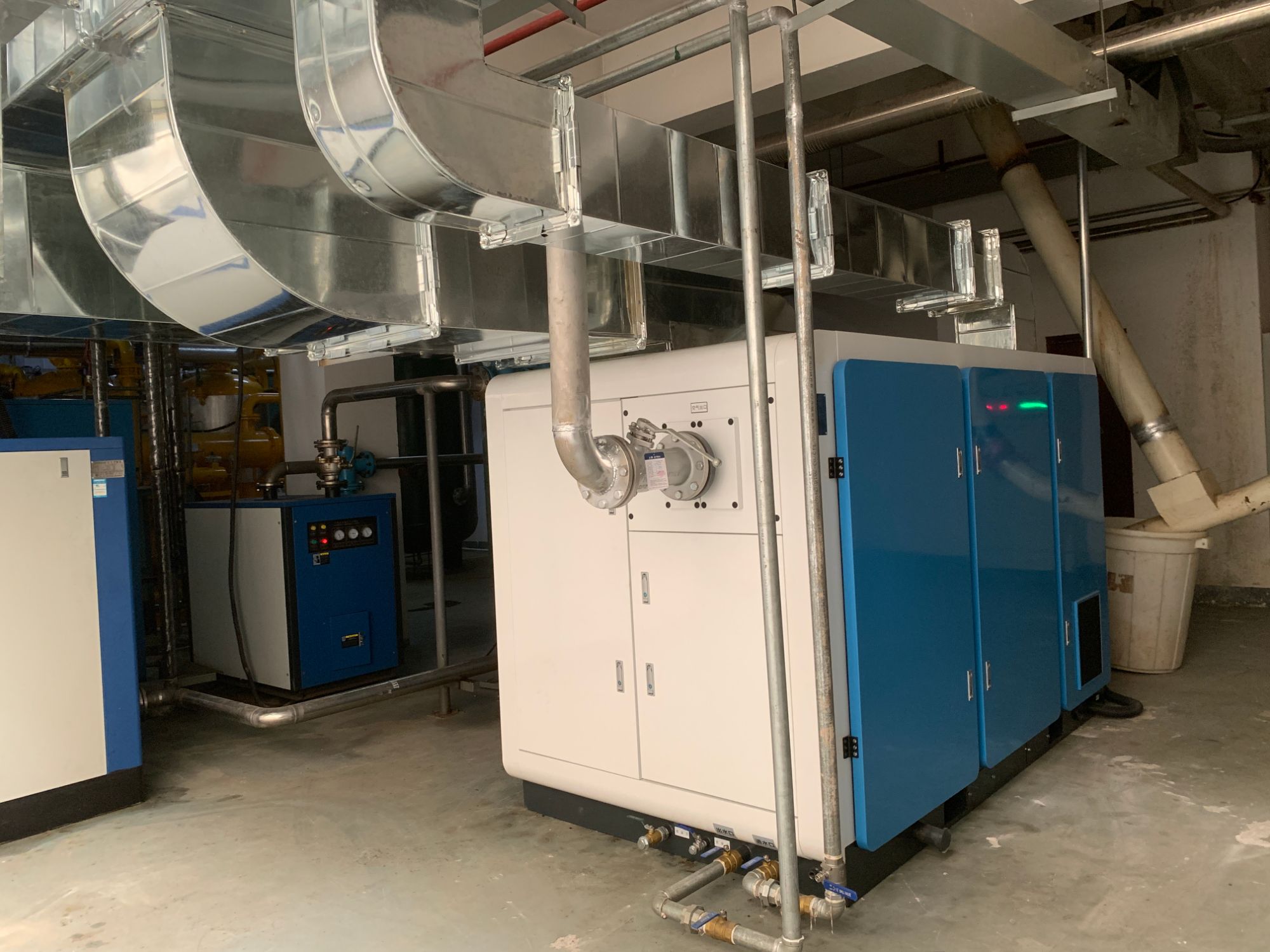
An oil-free design is usually framed as a way to avoid contamination, but that only scratches the surface. Once you remove oil from the equation, the entire machine architecture changes. Seals, bearings, cooling pathways, and even control logic no longer have to accommodate a lubricant that degrades, migrates, and demands constant attention. What emerges is a system that can be placed closer to sensitive processes, run in harsher environments, and start up faster after idle periods—things that a traditional lubricated design simply cannot promise.
The downstream effects are often underestimated. Without oil changes, filter replacements, or condensate treatment, service intervals stretch further and the total cost of ownership drops in ways that a simple feature list never captures. For food, beverage, pharmaceutical, and electronics manufacturers, this also means fewer audits, less paperwork, and one less variable in cleanroom or sanitary protocols. The initial price difference, if any, becomes almost irrelevant once you factor in years of avoided maintenance and production downtime.
What makes this shift genuinely interesting is how it forces a rethink of component materials and tribology. Dry-running surfaces depend on advanced coatings, self-lubricating polymers, and precision-engineered clearances. That expertise spills over into other product lines, raising the baseline for durability and efficiency across the board. In other words, oil-free is not a final destination; it is the starting point for a design philosophy that rewards simplicity, cleaner operation, and long-term resilience.
Navigating ISO 8573-1 and Pharmacopeia Requirements
Compressed air used in pharmaceutical manufacturing often sits at the intersection of two distinct frameworks. ISO 8573-1 defines purity classes for particles, water, and oil, but pharmacopeias such as USP and Ph. Eur. add their own expectations for microbial limits and endotoxin control. The challenge is that these documents were written for different purposes—one as a general industrial standard, the other as a regulatory safeguard for patient safety.
A practical approach starts with mapping how the air contacts the product. For air that directly touches sterile surfaces or primary packaging, the pharmacopeia's requirements for viable microorganisms and particulate matter take precedence, and ISO 8573-1 classes become a baseline rather than the final goal. This often means pairing a high-purity class like [1:2:1] with additional sterile filtration and routine monitoring to catch any drift.
One recurring mistake is treating ISO 8573-1 compliance as proof of pharmacopeial suitability. The standard does not address microbial viability, and a system can easily meet oil and moisture limits while still harboring biofilm in piping. Facilities that navigate this well tend to treat the ISO classes as a starting point for equipment selection, then layer pharmacopeial testing on top—measuring both what the standard defines and what the patient's safety truly requires.
Matching Compressor Output to Real Facility Load
Compressor selection often fails at the intersection of nameplate ratings and actual operating conditions. Real facility load rarely sits still—demand swings with production shifts, seasonal changes, and unplanned usage spikes. When the compressor is sized for peak theoretical demand, it ends up running at part load for most of its life, wasting energy through blowdown, modulation, or excessive start-stop cycles. A better approach starts with a detailed load profile over a representative week or month, capturing not just average CFM but also duration at each demand level, minimum flow requirements, and pressure stability tolerances. That data becomes the foundation for matching output not to a single number, but to a range of operating states.
The next step is configuring compressor capacity to track the load curve without overcooling or underfeeding the system. This can mean a combination of fixed-speed base units and a variable-speed trim compressor, or staged sequencing that brings smaller units online as demand rises. The goal is to minimize unloaded run time and avoid artificial demand caused by pressure drops. In facilities with intermittent high-flow events—like dust collector pulsing or air cannon blasts—the system may need a small storage receiver sized to flatten those peaks, letting the compressor run at a stable, efficient point instead of chasing transient spikes. Matching output to real load is less about right-sizing one machine and more about designing a supply system that flexes without waste.
Data logging and continuous verification are part of the match. After initial setup, the load profile will drift as production changes, leaks develop, or new equipment is added. Periodic re-measurement of flow, pressure, and power draw can reveal whether the compressor is still aligned with the facility's actual needs. When the gap widens, simple adjustments—changing pressure setpoints, resequencing units, or adding storage—often bring the system back into harmony at a fraction of the cost of replacing hardware. The result is a compressed air system that responds to real demand without the silent penalty of overcapacity.
Post-Installation Support and Performance Audits
After the installation wraps up, you're not left on your own. We schedule a follow-up visit within the first month to check how everything is settling in—bolts, seals, calibration points. If something feels off, even if it's just a faint hum you didn't expect, you can call and we'll come look. No ticket queues, no scripted phone menus.
Performance audits happen twice a year, usually spring and fall. We run the system through its paces under real load conditions, compare output or efficiency numbers against the baseline we recorded at handover, and flag anything drifting by more than a few percent. A short written report follows, with plain-language notes on what we changed, what's likely to need attention next season, and what you can ignore safely. If the audit turns up a component that's wearing faster than it should, we'll replace it under warranty before it becomes an emergency—often before you'd notice anything at all.
Controlling Moisture, Particles, and Microbial Risk
Managing moisture is rarely just about keeping surfaces dry; it directly shapes how particles behave and whether microbes can establish a foothold. In spaces where air quality matters, even small shifts in relative humidity can change the electrostatic charge on particles, affecting how they settle or stay airborne. Keeping humidity within a defined band—often between 40% and 60%—reduces the likelihood of condensation while avoiding overly dry conditions that encourage static buildup. The goal is not a single perfect number but a stable range that supports both material integrity and contamination control.
Particle control depends on understanding sources as much as on filtration. People, equipment movement, and even packaging generate particles that can carry microbial contaminants. A layered approach works best: source reduction through careful gowning and material transfer protocols, followed by appropriately staged filtration and controlled airflow patterns. Routine monitoring with particle counters provides trend data, but the real value comes from investigating excursions rather than simply recording them. When a spike occurs, tracing it back to a specific activity or maintenance event often reveals a preventable cause.
Microbial risk is rarely eliminated by a single intervention. It shrinks when moisture, particles, and human behavior are managed together. Disinfection programs, cleanroom design, and material selection all contribute, but they need to be reviewed against actual environmental data. Settle plates and contact plates offer snapshots, while continuous particle and humidity monitoring can signal conditions that favor microbial survival or growth. A practical control strategy treats these three factors as linked, not as separate checklists.
FAQ
They need to understand ISO 8573-1 air purity classes, provide documentation for validation, offer oil-free or oil-less designs suited to medical air, and have experience with cGMP environments. A general vendor might not know why dew point control or particle counts matter for patient safety.
Even tiny oil carryover can contaminate breathing air or damage sensitive downstream equipment. Oil-free compressors eliminate the risk of hydrocarbon exposure, reduce filtration burden, and simplify maintenance while meeting pharmacopeia standards.
Ask for full traceability on materials, validation packages, certificates of conformance, and test reports. The supplier should be comfortable with audits and able to map their equipment to USP, European Pharmacopoeia, or ISO 8573-1 requirements without hesitation.
Desiccant dryers for low dew points, coalescing filters and activated carbon towers for vapor removal, sterile-grade final filtration, and continuous dew point or particle monitoring. These pieces need to be sized together, not bolted on as an afterthought.
You can ask about their experience with clean utilities, how they handle redundancy and maintenance schedules without interrupting supply, their approach to controlling moisture and microbial growth, and whether they can provide reference sites in regulated manufacturing.
Medical air cannot stop during maintenance or failure. A good supplier will propose N+1 configurations, lead-lag controls, and remote monitoring so one unit can be serviced while the others carry the load. It's not just selling machines; it's designing around uptime.
Factory acceptance test results, materials certificates, surface finish reports for stainless contact parts, IQ/OQ protocols, and sometimes a risk assessment. The supplier should be able to collaborate with the facility's quality team rather than offering a one-size-fits-all package.
Yes, continuity matters. A supplier with trained technicians who understand the pharmaceutical environment can spot gradual performance drift, schedule predictive maintenance, and keep records that satisfy auditors. This reduces the burden on in-house staff and prevents compliance gaps.
Conclusion
In clinical and pharmaceutical production environments, medical air is not a commodity—it is a critical utility that touches patient respiration, instrument actuation, and clean process interfaces. A capable pharmaceutical air compressor supplier must treat purity as a measurable target rather than a marketing claim. The metrics that matter include residual oil content, pressure dew point, and particle and microbial counts under worst-case ambient conditions. Oil-free design removes one major contamination source, but it alone cannot guarantee compliance. Water vapor, condensate, piping biofilms, and intake particulates demand equally deliberate control. Suppliers familiar with ISO 8573-1 classes and current pharmacopeia monographs can translate those requirements into specific purification trains—coalescing filters, dryers, sterile-grade filtration—without compromising delivered pressure or dew point stability.
Beyond the equipment specification, real facility load rarely matches a datasheet. Peak demand from multiple ventilators, laboratory analyzers, or packaging lines can expose undersized receivers and undersized dryers. A supplier should evaluate compressed air demand profiles, pressure bands, and storage capacity to avoid dew point spikes during surge events. This engineering view extends into post-installation support: performance audits, filter replacement logs, dew point trend reviews, and periodic validation of microbial barriers. Rather than simply supplying hardware, the right partner helps maintain the documented evidence chain that regulators expect. That ongoing verification—not just initial commissioning—keeps the system defensible and the air supply genuinely high-purity over its entire life cycle.
Contact Us
Contact Person: Mia
Email: [email protected]
Tel/WhatsApp: +86 19821985894
Website: https://www.seize-air.com