

Reliable Centrifugal Air Compressor: Key Features and Maintenance Insights
2026-10-07
Every hour of unplanned downtime from a centrifugal air compressor is money bleeding silently from your bottom line. Reliability isn't a sticker on the housing—it's a design philosophy and a maintenance discipline working hand in hand. At Seize Air, we've seen firsthand how the right features and the wrong habits can make or break a system. This guide strips away the sales fluff and looks at what actually keeps these machines spinning when the pressure is on.
When Centrifugal Compressors Outperform Rotary Screw Units in Continuous Duty
For plants running air around the clock, the choice often comes down to how a machine handles a flat, unrelenting load rather than peak horsepower. Centrifugal compressors become the better fit when demand stays within a narrow band and inlet conditions are stable. They thrive on long runs where impeller speed stays near design, avoiding repeated starts and stops. Rotary screw units, by contrast, start to show their edge in part-load or dirty environments rather than steady-state operation.
The gap widens at larger volumes. A centrifugal machine compresses by accelerating air through impellers; with no rotors meshing and no oil injected into the compression chamber, there is less mechanical contact to generate heat and wear. Above roughly 1,500 to 2,000 CFM, a properly selected centrifugal can use 10-20% less energy per cubic foot than a rotary screw running fully loaded. Maintenance patterns shift too: screws need airend rebuilds and separator element changes on a schedule, while centrifugals can run for years with mainly bearing and seal checks if kept clean and dry.
The caveat is sensitivity to sudden demand swings. Centrifugal compressors can surge if flow drops too low. In continuous duty with a steady baseline and enough storage to absorb minor fluctuations, that weakness rarely surfaces. Operators who match the machine to the load curve, not just the nameplate CFM, usually find the centrifugal pays back its higher upfront cost through lower power bills and fewer interventions.
Vibration Signatures That Reveal Impeller Imbalance Before It Escalates
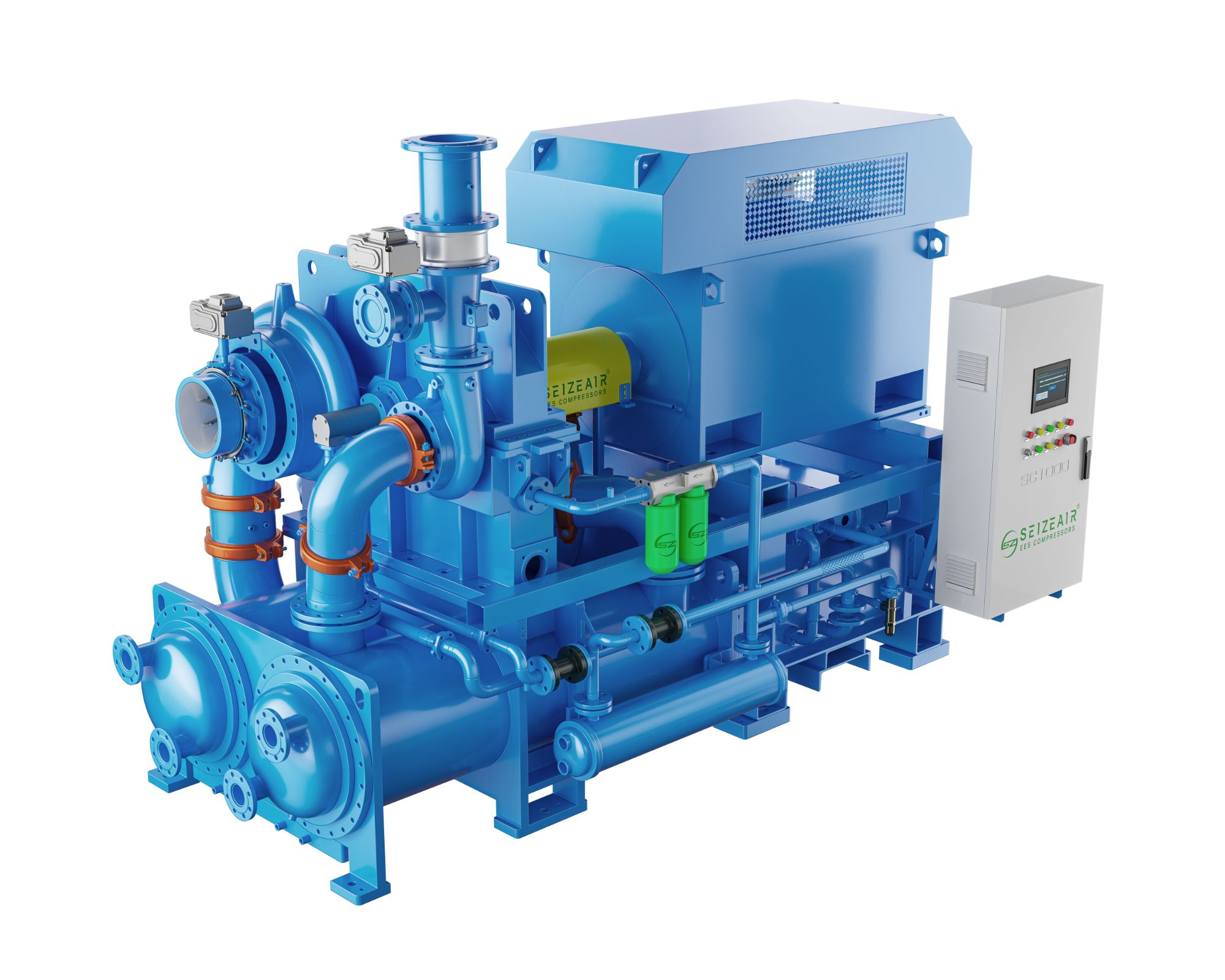
Impeller imbalance rarely announces itself with a sudden, dramatic failure. Instead, it leaves a trail of subtle vibrational clues that, if read early, can prevent costly downtime. The most telling signature is a dominant peak at the impeller's rotational frequency—commonly called 1X—that rises steadily in amplitude as imbalance worsens. Unlike other faults that spread energy across harmonics, pure imbalance tends to concentrate vibration at this single frequency, making it a reliable early indicator.
Phase measurements add another layer of certainty. When imbalance is the culprit, the phase angle between the vibration signal and a fixed reference point remains stable across repeated runs, unlike looseness or misalignment which often produce erratic phase readings. This stability, combined with a radial vibration pattern that is typically higher in the horizontal direction than vertical, helps technicians distinguish imbalance from other rotating equipment issues before they escalate.
Trending these signatures over time is where the real value lies. A gradual, linear increase in 1X amplitude without changes in operating conditions points strongly to progressive impeller wear or material buildup. Catching this trend while the vibration is still within acceptable limits allows for planned maintenance—such as cleaning or balancing—rather than reacting to a bearing failure or shaft fracture later.
Why Water-Cooled Heat Exchangers Need More Attention Than the Manual Suggests
Most manuals treat water-cooled heat exchangers as if they operate in a clean, steady-state world. Real cooling water rarely matches that assumption. It carries dissolved minerals, suspended solids, biological growth, and sometimes process leaks. Even with a chemical treatment program, the actual heat transfer surfaces gradually accumulate scale and biofilm. The manual might mention annual inspections, but a unit that runs 24/7 under variable load needs someone checking pressure drop, approach temperature, and water chemistry at least monthly. Ignoring these signs for even a few weeks can push a heat exchanger into a fouling spiral where efficiency drops and energy costs climb without any obvious alarm.
The second blind spot is mechanical stress. Handbooks often focus on thermal design, but they underestimate the damage from thermal cycling and water hammer. Each startup and shutdown creates expansion and contraction across tube sheets, baffles, and gaskets. Over time, small leaks start at tube-to-tubesheet joints, allowing cooling water to mix with the process fluid. By the time the leak is visible, corrosion has usually already spread along crevices. A quarterly borescope inspection or eddy current test on a sample of tubes would catch this early, but very few facilities schedule that unless a failure forces their hand.
Finally, water-cooled heat exchangers are often treated as passive components—install them, forget them. Yet their performance directly influences downstream separators, reactors, and compressors. A 10% reduction in heat duty might not trip any alarm, but it can shift a distillation column's reflux ratio, stress a compressor's intercooler, or reduce product purity. The manual's recommended cleanings assume a fixed fouling factor that rarely matches reality. Paying closer attention to actual operating data, not just design specifications, lets you schedule cleanings before problems cascade through the plant.
A Field-Tested Lubrication Routine for Stable Discharge Pressure
On most rotary pumps and compressors, a wandering discharge pressure is rarely a control problem at first—it's usually a lube film that's breaking down under load. The routine we've settled on starts before startup: pull a small oil sample into a clear bottle and hold it to the light. Cloudiness, water droplets, or a dark varnish smell means the oil has already lost its shear stability, and no amount of throttle adjustment will hold the discharge steady. We log the sample number and the hour meter reading, then top up only with the exact viscosity grade listed on the pump tag. No "close enough" multi-viscosity substitutions.
The next step is grease, and this is where most field crews overdo it. A bearing packed to the brim pushes grease into the windings or seals, causing drag that shows up as a slow pressure sag after an hour of running. Instead, we use a calculated shot: bore diameter in inches times 0.1 ounces for standard pillow blocks, half that for sealed bearings. Automatic single-point lubricators on hard-to-reach skids have cut our pressure swings by more than half, simply because they deliver the same amount at the same interval every week. The discharge gauge then only moves when the process actually changes.
Finally, we treat the lube schedule as a living record. Every three months, we overlay the discharge pressure trend with the oil analysis report. If viscosity has dropped more than 10% or the acid number is climbing, we shorten the drain interval before chasing a valve or a wear ring. One field trick that has saved us several tear-downs: when pressure starts drifting at constant speed, feel the oil return line. If it's hotter than usual by more than a few degrees, the film is shearing and internal leakage is already increasing. Catching that early keeps the discharge steady without touching the setpoint.
How Ambient Conditions Quietly Reshape Compressor Performance Curves
Compressor performance curves are usually plotted against a fixed set of inlet conditions, but the real world rarely holds still. A shift in ambient temperature alters air density before the first compression stage even begins. Hotter intake air is thinner, so the mass flow drops for the same volumetric displacement, and the curve sags downward across the entire pressure ratio range. Operators often notice this as a subtle loss of discharge pressure during afternoon heat, even when system demands haven't changed.
Humidity adds another quiet distortion. Water vapor is less dense than dry air, so moist conditions reduce the actual oxygen and nitrogen mass available per cubic meter. On a psychrometric chart the effect looks small, but on a compressor map it nudges the surge line inward and slightly lowers efficiency islands. The machine may still sound normal while working a few percentage points harder to deliver the same process flow.
Altitude works more gradually but with a firmer hand. At higher elevations, lower inlet pressure means the compressor starts closer to vacuum conditions, shifting the entire operating window toward higher pressure ratios for the same discharge target. This can push a machine that was comfortably mid-map at sea level dangerously close to surge or choke when the same model is installed on a plateau. The performance curve doesn't just move; its usable margin quietly shrinks.
The Maintenance Oversight That Leads to Surge and Choke Events
Most surge and choke incidents trace back to a few overlooked maintenance items that quietly erode aerodynamic stability. Inlet filtration that hasn't been replaced on schedule allows dust and debris to accumulate on compressor blades, reducing efficiency and shifting the operating point closer to the surge line. Bleed valves and blow-off lines that are not exercised during routine checks may stick or respond slowly, eliminating the fast relief path needed when pressure ratios climb unexpectedly. These issues rarely show up in daily logs, but they change how the machine behaves when ambient temperatures swing or load demand spikes.
Another common gap involves calibration drift in pressure and temperature sensors that feed the anti-surge control system. When maintenance teams skip verifying these instruments against known references, the controller operates on a distorted view of the actual aerodynamic condition. Variable inlet guide vanes with worn bushings or misaligned linkages can also alter the angle of attack across the first stages, pushing local flow separation closer to stall. Lubrication neglect on the anti-surge valve actuator adds hysteresis, so the valve either opens too late or too far, causing alternating surge and choke cycles rather than a smooth recovery.
The pattern repeats when cleaning schedules are treated as optional. Moisture separators left unchecked allow droplets into the compression path, changing gas density and invalidating the expected performance map. Even a small wrap of fibrous material around a temperature probe can delay readings enough to mask a developing instability. By the time operators notice the characteristic low-frequency rumble or rapid flow fluctuations, the aerodynamic margin has already shrunk below safe limits. Correcting these maintenance oversights usually restores the intended distance from both surge and choke boundaries without requiring complex control retuning.
FAQ
Centrifugal machines move air continuously rather than trapping it in batches or lobes. That steady flow, combined with fewer rubbing parts and no oil carryover in the air path, removes many of the failure points you see in positive-displacement designs. The result is less vibration-induced wear and a narrower set of things that can go wrong during normal operation.
The impeller and the bearings set the tone. A well-balanced, corrosion-resistant impeller keeps aerodynamic loads predictable, while properly selected tilting-pad or magnetic bearings handle the high rotational speeds without metal-to-metal contact. Close attention to shaft sealing and thrust balance also prevents the kind of slow degradation that often gets blamed on poor maintenance but actually starts with marginal component choices.
Far more than most people assume. Centrifugal compressors pull in huge volumes of air, and even fine particulates can erode impeller blades or unbalance the rotor over time. A multi-stage filtration setup with differential pressure monitoring keeps the air clean and alerts you before a clogged element starts choking performance or forcing the compressor into surge territory.
Consistent oil sampling and analysis, vibration trend tracking, and regular checks of intercooler and aftercooler performance. These three activities catch most problems while they are still cheap to fix. Oil analysis reveals bearing or seal wear early. Vibration data shows imbalance or resonance before it becomes a failure. Cooler inspections prevent thermal stress and moisture carryover that quietly erode internal clearances.
Surge is a flow reversal that happens when discharge pressure exceeds what the impeller can sustain at a given speed. It hammers the thrust bearing, flexes the rotor, and can destroy seals in seconds. Unlike reciprocating units that simply stall a valve, a centrifugal machine stores considerable energy in the compressed gas, so a surge event releases that energy backward through the machine. That is why anti-surge controls and blow-off valves are considered safety-critical, not optional.
Subtle changes in vibration signature, rising oil temperature without a corresponding load increase, or a slow upward drift in thrust position. You might also see oil consumption creep up or hear a faint high-frequency whine that changes with discharge pressure. The trick is to compare current data against baseline readings from when the machine was healthy; isolated numbers rarely tell the whole story.
Yes. Very low flow demands combined with high discharge pressure can push the machine into repeated surge cycles unless the control system is exceptionally well tuned. Frequent starts and stops also add thermal cycling stress to the rotor and seals, which shortens their life faster than steady operation. In those scenarios, a rotary screw or reciprocating unit may prove more forgiving, but for constant high-volume air needs, the centrifugal design shines.
Conclusion
Centrifugal air compressors only earn the "reliable" label when their strengths match the application. In continuous duty, they often outrun rotary screw units because the compression path avoids oil carryover and the specific power stays lower at high flow. But that advantage vanishes if operators assume the performance curve is fixed. Ambient conditions rewrite it daily: a 10°C rise in inlet temperature or a dip in barometric pressure can shift the surge line enough to push a stable machine toward instability. Vibration monitoring gives the earliest clue when something starts to drift. Instead of waiting for overall levels to climb, look for a once-per-revolution component on the impeller end; that signature usually points to imbalance before the bearings complain. Water-cooled heat exchangers deserve more scrutiny than the manual implies. Approach temperature and pressure drop across the cooler reveal fouling or low coolant flow long before discharge temperature forces a shutdown.
The maintenance routine that actually holds discharge pressure steady is not complicated. A field-tested lubrication schedule—checking oil film pressure, draining condensate, and logging pressure after each filter change—catches small problems before they become surge events. Surge and choke often get treated as separate emergencies, but in practice they share the same root: ignored inlet conditions, dirty intercoolers, or worn seals. A compressor that hums along at 85% load can surge during a fast unload if the maintenance drift has narrowed the stable operating window. Reliability is not one feature. It is the result of matching a centrifugal design to continuous duty and then tracking trends instead of reacting to alarms.
Contact Us
Contact Person: Mia
Email: [email protected]
Tel/WhatsApp: +86 19821985894
Website: https://www.seize-air.com